What Reiki Actually Does to a Stressed Nervous System
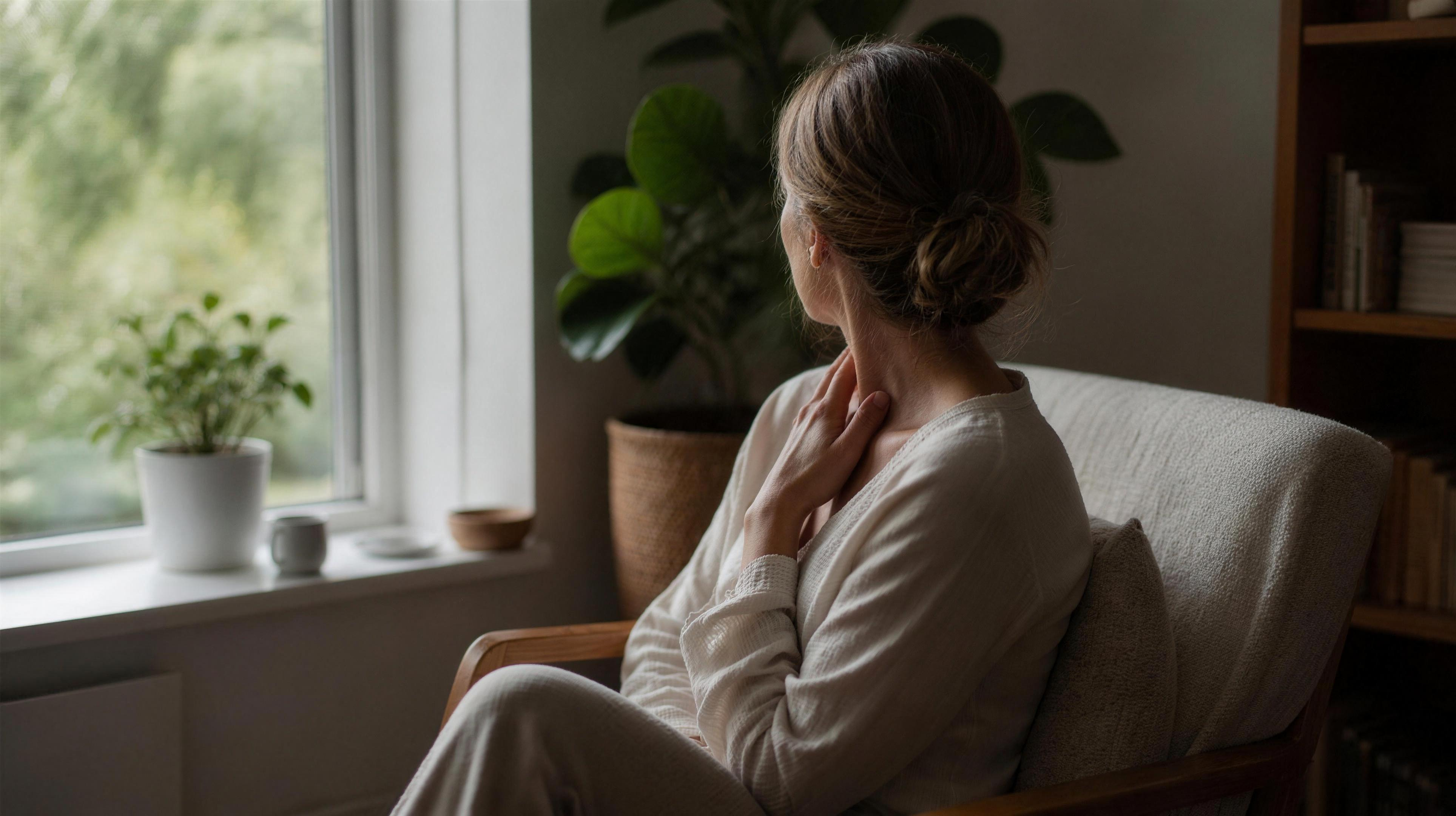
If you have been carrying stress for long enough that it has stopped feeling situational, you have probably already tried the obvious fixes. Sleep more. Breathe deeper. Cut the caffeine. Some of it helped a little. None of it touched the part that seems to switch back on the moment you sit still. That is usually the point where someone first hears about Reiki, often from a friend who mentions it almost apologetically, and wants to know whether there is anything to it beyond a nice hour of quiet.
This is for you if what brought you here is not curiosity about energy healing in the abstract, but a nervous system that will not stand down. Your autonomic nervous system, what a session involves, and what the research does and does not support all matter more here than the mystique. Nothing here promises a fix. What it can offer is a clear, honest picture of where this practice sits alongside your regular medical care, not instead of it.
The short answer
Reiki nervous system research suggests this gentle, non-invasive practice of light or near-body touch may shift measurable markers of autonomic activity, such as heart rate variability, toward a calmer, more parasympathetic state. The evidence is real but still limited: study samples are small, findings are inconsistent across trials, and no scientific evidence supports the specific energy field Reiki is traditionally said to work through.
What Reiki is, without the mystique
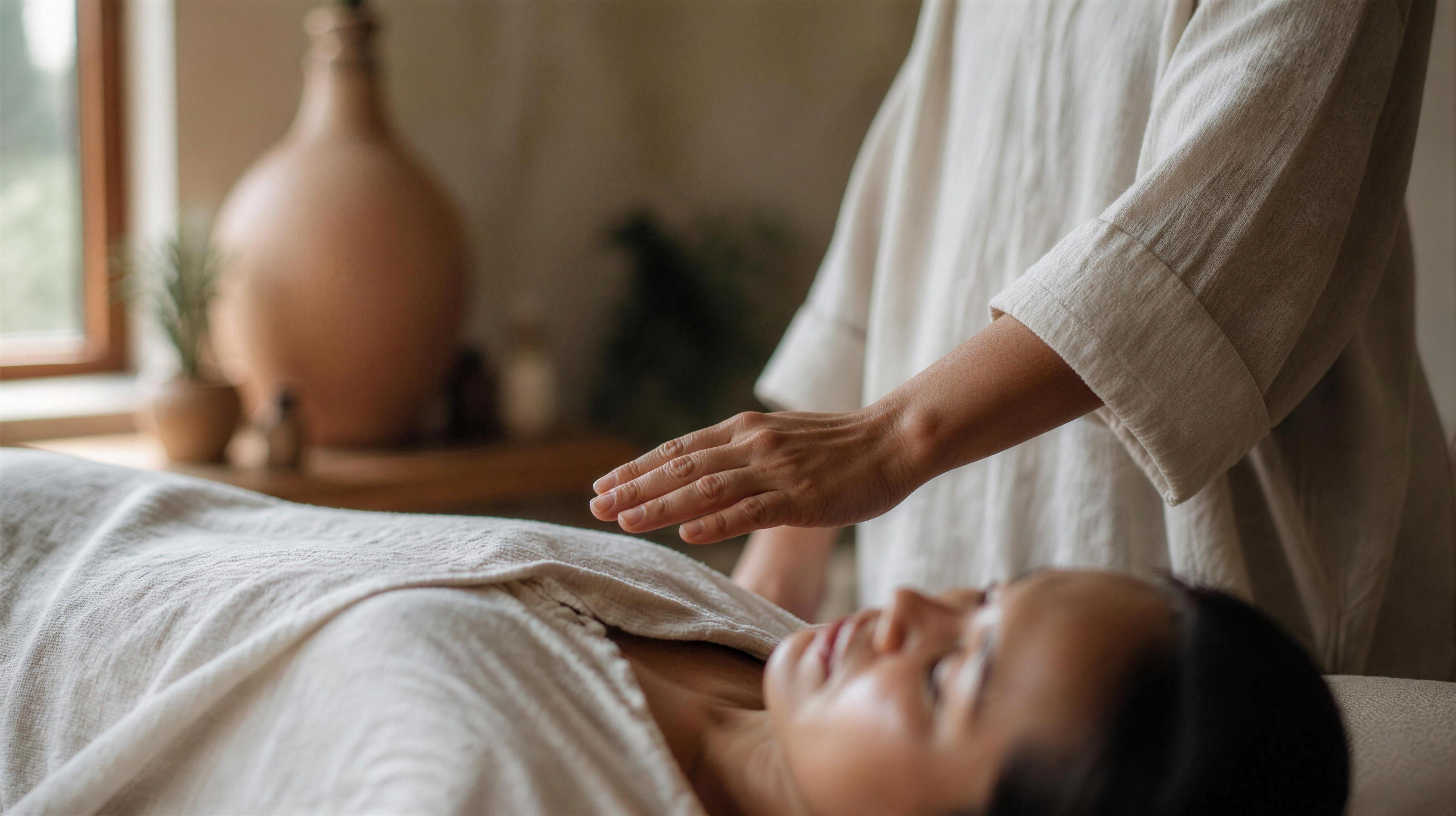
Reiki is a Japanese practice developed by Mikao Usui in the 1920s, in which a practitioner rests their hands lightly on or just above a person's body in a series of positions, with the stated aim of supporting the person's own capacity to settle and recover. There is no manipulation, no pressure, and no requirement to undress beyond removing shoes.
Traditionally, the practice is explained through the idea of an energy, sometimes called a biofield, that the practitioner is said to direct or channel. That explanation has cultural and historical weight. It has almost no scientific support. The National Center for Complementary and Integrative Health states plainly that there is no evidence for the existence of the energy field Reiki is thought to work through, and that Reiki "hasn't been clearly shown to be effective for any health-related purpose." Holding both of those facts at once, an unproven traditional explanation and a genuinely calming lived experience, is not a contradiction. It is where most integrative practices sit.
Fight, flight, or something in between
Your body runs on two competing autonomic settings, and most chronic stress is really a story about one of them getting stuck. The sympathetic branch prepares you for threat: faster heart rate, shallower breath, blood pushed toward muscle over digestion. The parasympathetic branch, sometimes summarized as rest and digest, does the opposite, and it depends heavily on the vagus nerve, the main channel carrying those calming signals between brain and body.
Neither state is the villain. A functioning nervous system moves between them constantly, all day, without you noticing. The pattern that brings people to integrative work is different: sympathetic activation that does not fully stand down even in objectively safe conditions, so that rest itself starts to feel effortful. Researchers can track this shift with heart rate variability, a measure of the tiny beat-to-beat timing changes in your heartbeat. Higher variability generally reflects a more flexible, better-regulated autonomic system; a flattened pattern often accompanies chronic stress and burnout.
The physiology behind an hour of stillness
A Reiki session removes several ordinary demands on your nervous system at once, and that alone is not nothing. You are lying or sitting still, in a quiet room, for thirty to sixty minutes, being touched lightly and predictably, with nowhere to be and nothing to perform. Sensory input drops. Time pressure drops. For a nervous system that spends most of its day scanning for the next demand, that combination is unusual.
Whether something beyond stillness and touch is happening is the harder question, and it is the one the research below tries to answer. The honest position is that stillness, attention, and non-demanding human contact are each independently associated with parasympathetic activation, and Reiki delivers all three reliably. What is not established is that an energy transfer, rather than those ordinary ingredients, is doing the work.
Where Reiki nervous system research currently stands
The burnout study researchers keep citing
A frequently cited 2011 trial in Biological Research for Nursing studied 21 female healthcare workers diagnosed with burnout syndrome, using a randomized, placebo-controlled crossover design so each participant received both a real Reiki session and a convincing sham version. After the genuine session, a heart rate variability marker called SDNN rose significantly, and the low-frequency component of the signal, associated with sympathetic drive, dropped significantly. Body temperature rose measurably as well. Cortisol trended downward but did not reach statistical significance. Only 19 percent of participants correctly guessed which session had been real, which is itself notable: whatever produced the physiological shift was not obvious to the people experiencing it.
What broader reviews say, and where they stop
The University of Minnesota's Center for Spirituality and Healing, summarizing the wider body of research, notes that data from the stronger available studies support Reiki's ability to reduce anxiety and pain, with additional signals around relaxation, fatigue, and depressive symptoms. In the same summary, the authors are direct about the limits: most studies are small, not all are well designed, and some of what people report, such as a sense of connection or ease, may not be the kind of thing a heart rate monitor was built to capture. Reiki research is still, by most honest accounts, at an early stage.
Where people are turning to this
Most people who try this are not chasing a cure; their stress simply stopped being an event a while ago and became a baseline instead.
Chronic stress and burnout. This is the population the strongest study above was drawn from, and it lines up with the everyday reason people show up: a nervous system that no longer downshifts on its own, even when the actual threat has passed.
Alongside medical procedures. A number of hospital and cancer center integrative medicine programs now offer Reiki sessions around surgery, chemotherapy, or hospice care, generally as a comfort measure sitting beside standard treatment, never in place of it.
Sleep and general overstimulation. People who describe being wired but tired, unable to downshift at the end of a day, often report the session itself as the first hour in a while where nothing was asked of them.
Alongside talk therapy or somatic work. Some people bring Reiki in as one part of a broader approach that already includes therapy or body-based practices, using the session as a period of low-demand attention rather than a replacement for either.
How an integrative approach can extend what Reiki alone offers
In my practice, Reiki rarely works alone. I trained to Master/Teacher level in Reiki, and I also draw on Traditional Chinese Medicine-informed work, somatic and body-mind attention, and breathwork, choosing whichever combination fits what is in front of me that day rather than running the same sequence regardless of who is on the table.
A nervous system stuck in overdrive for months rarely responds to one lever pulled the same way every time. Some people need long, quiet stillness. Others need help noticing what their breath is already doing before anything else can settle. A pattern that keeps returning to the same place, at the same times, under the same conditions is usually saying something about how you have been living, not only misfiring, and unhurried attention to your own history is the part a short medical appointment was never built to hold.
This does not replace your doctor. It is simply the quieter piece that sits beside whatever medical care you are already getting. Sometimes something shifts. Sometimes it does not, and I would rather tell you that plainly than promise a result before we have spent any time together.
The strongest evidence in Reiki's favor
Start with the least exciting claim, because it happens to be the sturdiest one. Nobody in the published research has reported Reiki causing harm, which tracks with what the practice involves: light contact, no substances, nothing invasive. That much is solid.
Past that point the evidence thins out. A single placebo-controlled trial found real Reiki shifted heart rate variability and skin temperature more than a convincing sham version did, a real physiological signal from one study that has not been repeated nearly enough to call it settled. Broader reviews report less anxiety and pain among people receiving Reiki, though most of that evidence comes from small, self-reported studies, the weakest kind on this list. What holds up regardless of how the mechanism debate ends is simpler: you get an uninterrupted hour where nothing is asked of you, and nothing about the practice interferes with medication or other treatment you are already receiving.
None of that adds up to a cure, and no one should tell you it does.
What Reiki does not do
Reiki has not been shown to diagnose, treat, cure, or prevent any disease, and no credible practitioner should tell you otherwise. It is not a substitute for medical or psychological care, and any new, worsening, or unexplained symptom belongs in front of a doctor first, not a Reiki table. Frameworks that connect specific emotions to specific physical patterns can be useful as a way to reflect on your own experience. They are not an explanation of why you developed a particular condition, and treating them as one does a disservice to people carrying illness that has nothing to do with what they have or have not processed emotionally.
Inside a session built for nervous system support
You typically stay fully clothed, seated or lying on a treatment table, in a quiet room with low lighting. The practitioner's hands rest lightly on or just above your body through a series of positions, usually working from head toward torso and limbs, for a total session length of thirty to sixty minutes. You are not required to talk, and you are not required to feel anything specific: some people notice warmth, tingling, or a pull toward sleep; others feel simply relaxed; some notice very little in the moment and only register the effect afterward, in how their evening goes.
Who this may be worth considering for
Reiki nervous system support tends to suit people already engaged with medical care who want a non-invasive way to spend an hour attending to a body that has been carrying tension for a long time, rather than people looking for a first or only intervention. If what you are carrying is new, sudden, or worsening, see your doctor before you see a Reiki practitioner, and keep them informed either way. Persistent stress deserves attention. So does anything your body is telling you that a session alone is not equipped to interpret.
Key takeaways
- Keep seeing your doctor for anything new or persistent, and treat sessions as a supplement to that care rather than a stand-in for it.
- Judge a session by how you feel afterward rather than by which mechanism eventually gets credited, since the research on why remains unsettled.
- Expect gradual, cumulative shifts rather than one dramatic turning point. The measured effects in research to date are real but modest.
- How many sessions this takes is not something evidence can answer. Decide, in your own time, whether one visit or a short series fits the pattern you are carrying.
- A practitioner who frames Reiki as complementary, and who does not claim to explain your diagnosis, is describing the practice accurately.
Definitions
Heart rate variability (HRV): The variation in time between successive heartbeats, used as a measurable indicator of autonomic nervous system balance and flexibility.
Vagal tone: The activity level of the vagus nerve, the primary channel through which the parasympathetic nervous system slows heart rate and supports recovery.
Cortisol: A hormone released by the adrenal glands in response to stress, commonly measured in stress research through saliva samples.
Biofield: The term used in complementary medicine research for the proposed energy field that practices like Reiki are traditionally said to work through, and for which no scientific evidence currently exists.
Burnout syndrome: A state of chronic work-related stress marked by exhaustion, detachment, and reduced sense of accomplishment.
Frequently asked questions
Can Reiki actually calm my nervous system, or is it just the effect of lying still for an hour?
Likely both, and the research cannot yet fully separate them. A placebo-controlled study on burned-out healthcare workers found a real Reiki session produced significantly different heart rate variability and temperature changes than a convincing sham version, suggesting more than stillness alone is at work, though the sample was small and the finding needs replication.
Is there real scientific proof that Reiki affects the body, or is it a placebo?
Neither claim fully holds up. Federal health researchers state Reiki has not been clearly shown effective for any health condition and that no evidence supports its proposed energy mechanism, while separately noting it has not been shown to cause harm. The honest position is unproven benefit with essentially no risk, not proof in either direction.
How many Reiki sessions before I should expect to feel calmer?
There is no research-backed number, and any practitioner promising one is overstating the evidence. Some people notice a shift in mood or sleep after a single session; others find value only after a short series. Let your own response guide the pace rather than a fixed schedule.
Can Reiki help with anxiety specifically, or only general stress?
Aggregated review evidence points toward some reduction in anxiety and pain across studies, alongside general relaxation. It has not been studied or shown to substitute for therapy or medication for diagnosed anxiety disorders, and works best as an addition to that care rather than a replacement for it.
Is it safe to do Reiki while I'm on medication or in active medical treatment?
Yes, since nothing is applied, ingested, or manipulated that could interact with your treatment, and no studies have reported adverse effects. Tell both your practitioner and your doctor what care you are already receiving so the session fits around it rather than around a gap in your history.
What if I don't feel anything during or after a session?
Feeling nothing in particular is common and does not mean the session failed or that you are doing something wrong. Some people notice warmth, tingling, or drowsiness in the moment; others only register a change later, in sleep quality or general ease, and some notice very little either way.