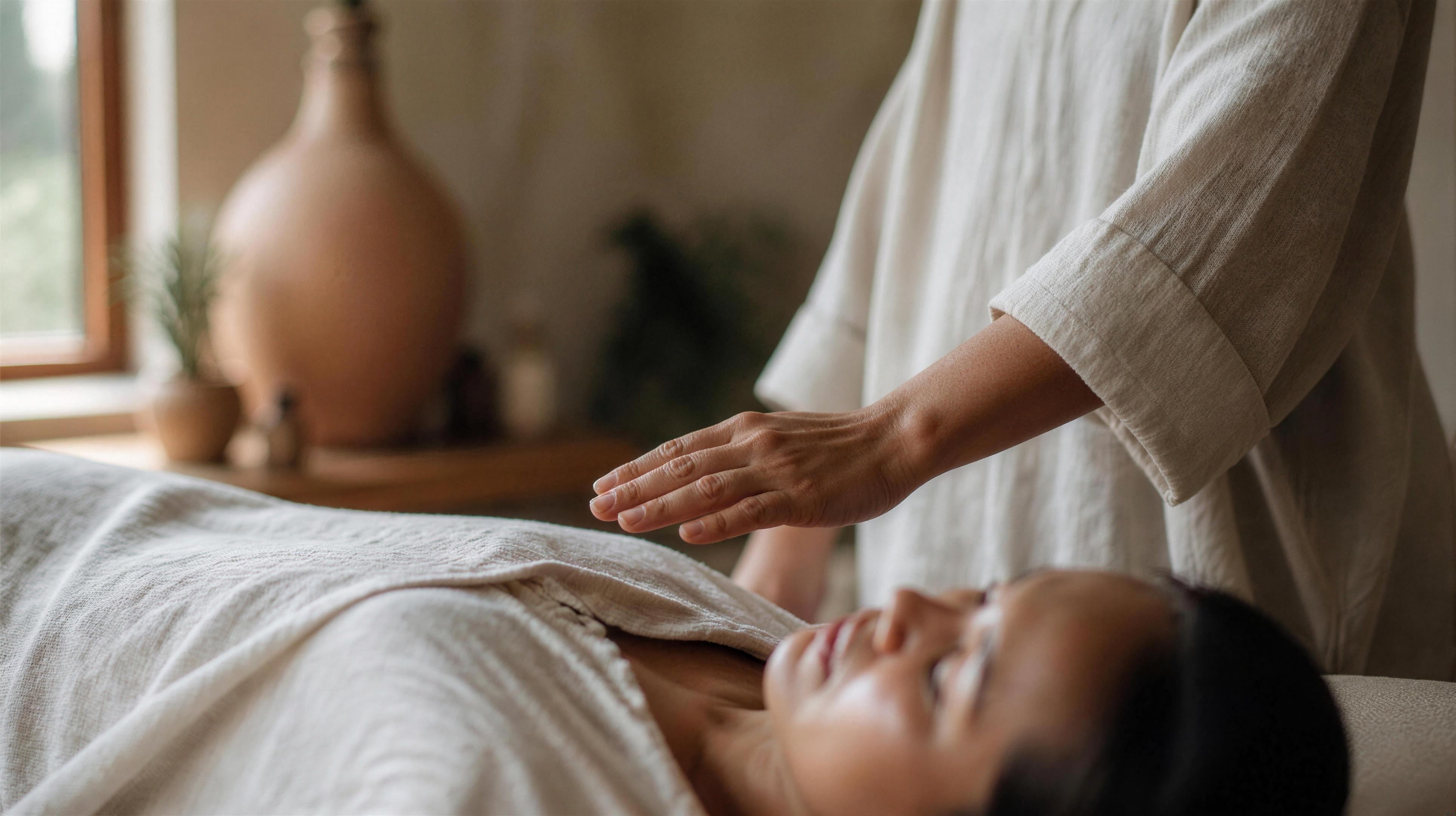
Booking a first Reiki session can feel oddly exposing. You are about to lie down, close your eyes and let someone you barely know place their hands near your body, and you may not be sure what you are supposed to feel, do or believe. Some people arrive curious. Others arrive a little embarrassed to be there at all.
This is for you if you are about to book, or have booked, and want to know what actually happens in the room. Knowing the shape of the hour in advance is one of the simplest ways to make it feel safe.
The short answer
A first Reiki session usually lasts about an hour and moves through four stages: a conversation about what brought you, a short preparation where you agree on touch and how to pause, around 45 minutes of hands-on or hands-above Reiki while you lie clothed and still, and a slow return at the end. You do not need to believe anything or feel anything specific for the session to be worthwhile.
Before you arrive: how to prepare
A little preparation helps your body arrive ready to rest.
- Eat lightly. A small meal an hour or two before is ideal. A full stomach or an empty one both make it harder to settle.
- Wear soft, loose clothes. You stay fully clothed, so comfort matters. Layers help, since the body often cools as it relaxes.
- Leave time on either side. Rushing in from a meeting, or straight out to one, keeps the nervous system on alert. Give yourself a buffer.
- Notice what you are carrying. You do not need a goal. It can help to arrive knowing roughly what is heavy right now, even if it is just "I'm tired."
Stage one: arriving and talking
Your first Reiki session begins with a conversation, and in my practice this part is never skipped. I ask what brought you, how you are sleeping and feeling, and anything about your health or history you would like me to know. There is no need to tell your whole story. Share what feels right.
This is also your moment to ask questions. What will you feel? What if you fall asleep? What if nothing happens? All of these are welcome, and none of them is silly.
Stage two: preparation and consent
Preparation is where we agree on how the session will be held. The most important part is touch. You choose whether my hands rest lightly on your body, hover a few centimetres above it, or stay away from certain areas entirely. You can change your mind at any point during the session, and I will check in.
We also agree on a simple way to pause or stop, whether that is saying a word, lifting a hand or opening your eyes.
Then I prepare myself. Before any session I ground, take a moment of Gassho with my hands together at the heart, and practise Reiji-Ho, asking Reiki to guide my hands to where attention is needed. It takes a minute or two, and it shapes the whole hour. A settled practitioner helps a client settle.
Stage three: the hands-on practice
You lie on the treatment table on your back, fully clothed, usually under a light blanket. I work from the crown of your head toward your feet, holding each position for around three minutes and adjusting by feel. When I move between positions, one hand stays in contact while the other moves, so the connection is never fully broken.
There is no massage, no pressure and no manipulation. Most of the session happens in silence. You do not need to do anything, meditate "correctly" or keep your eyes closed.
People notice all kinds of things: warmth under the hands, a heavy, sinking feeling, tingling in places far from where the hands are, tears with no clear story, or deep sleepiness. Some notice very little and simply feel rested afterward. In Reiki teaching, warmth is read as energy being welcomed and coolness as the body taking what it needs. Whatever you feel is simply what your body is doing today.
If you are curious about what may be happening in the body during that hour of stillness, I go deeper in what Reiki actually does to a stressed nervous system.
Stage four: integration and the quiet after
When the hands-on practice ends, I let you lie for a moment before you move. Then you sit up slowly, drink some water and notice how your body feels compared to when you arrived. We can talk about what came up, or stay quiet. Both are fine.
In the day or two after, you may feel lighter, sleepy, emotional or unusually tender. Occasionally a pattern that has been held for a long time stirs before it settles, and you feel a little worse for a day before feeling better. Rest, water, a gentle walk and an early night help.
The five Reiki precepts you may hear about
Many practitioners, including me, keep the five Reiki precepts close. You may hear them at the start of a session or see them on the wall:
- Just for today, do not worry.
- Just for today, do not anger.
- Just for today, respect all life.
- Just for today, work honestly.
- Just for today, be grateful.
They are simple on purpose. Some people find that repeating them in the days after a session helps carry the calm into ordinary life.
How many sessions, and what next
There is no fixed number. One session is enough to know whether Reiki suits you. If it does, some people come every week or two through a stressful stretch, and others return only when they feel the need. Reiki also sits naturally alongside somatic work or breathwork when something that surfaces wants more attention.
I can promise attention, time and care. A specific result is something I won't promise, and I would rather say that plainly before we begin.
Key takeaways
- Book a time with a buffer before and after, so you are not rushing in or out.
- Decide how you feel about touch before you lie down, and say it out loud.
- Let go of any expectation of what you should feel; a quiet session still counts.
- Plan a gentle evening after your first session.
- Try one session before deciding whether a series makes sense for you.
Definitions
Gassho: A short centring practice with the hands held together at the heart, used before Reiki.
Reiji-Ho: The practice of asking Reiki to guide the practitioner's hands to where attention is needed.
Hands-off Reiki: Reiki given with the hands held a few centimetres above the body.